
Rice Cooker vs Pressure Cooker: Which Is Better?
Compare rice cookers, stovetop pressure cookers and electric pressure cookers to find the right option for your U.S. kitchen.
Rice Cooker vs Pressure Cooker: Which Is Better?
Choosing between a rice cooker vs pressure cooker depends on what you cook most often, how much convenience you want, and whether you need a dedicated rice appliance or a versatile multi-purpose cooker.
A rice cooker is designed primarily for cooking rice and grains with minimal supervision. A pressure cooker, however, uses high-pressure steam to cook many foods faster, including rice, beans, meats, soups, stews, and vegetables.
For U.S. households, there is another important distinction: stovetop pressure cookers and electric pressure cookers are not the same. A stovetop model requires a burner and more hands-on control, while an electric pressure cooker automatically manages pressure and temperature and often provides additional cooking functions.
Therefore, the best choice depends on your cooking habits. This guide compares a rice cooker vs pressure cooker based on cooking performance, convenience, versatility, safety, energy use, cleaning, cost, meal preparation, and everyday use in an American kitchen.
Rice Cooker vs Pressure Cooker: Quick Comparison
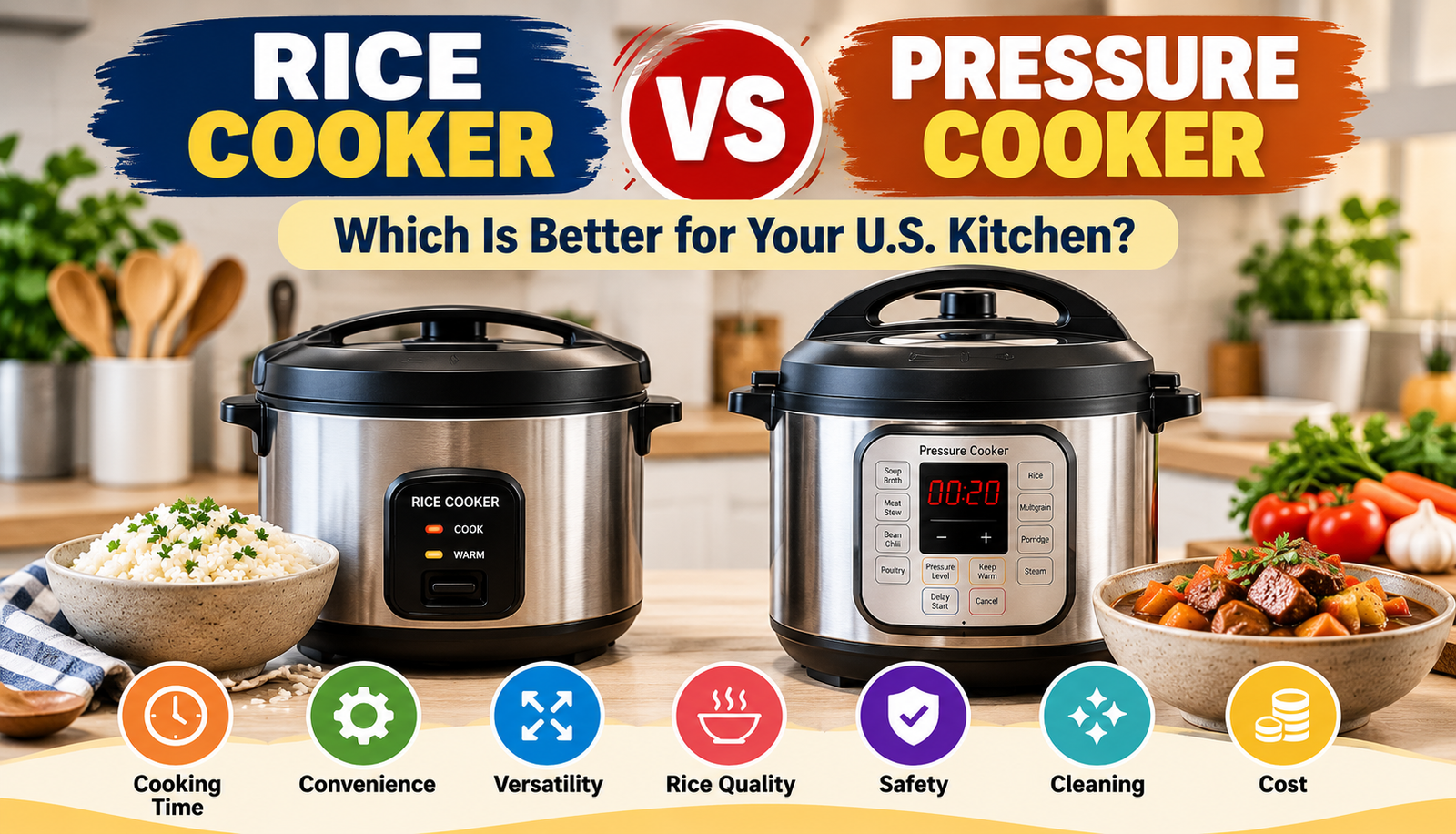
| Feature | Rice Cooker | Stovetop Pressure Cooker | Electric Pressure Cooker |
|---|---|---|---|
| Primary purpose | Rice and grains | Fast pressure cooking | Very good |
| Ease of use | Excellent | Moderate | Very good |
| Hands-off cooking | Excellent | Low | Excellent |
| Cooking speed | Moderate | Fast | Fast |
| Versatility | Moderate to high | High | Very high |
| Beans and legumes | Good on some models | Excellent | Excellent |
| Meat and stews | Limited on basic models | Excellent | Excellent |
| Soups and chili | Limited | Excellent | Excellent |
| Steaming | Common on many models | Available | Common |
| Slow cooking | Some models | No | Often available |
| Sautéing | Usually limited | Stovetop cooking | Often available |
| Keep-warm function | Common | No | Common |
| Pressure control | Not applicable | Manual/regulated | Automatic |
| Cleaning | Usually easy | Moderate | Moderate |
| Best for | Frequent rice cooking | Traditional pressure cooking | Convenience and versatility |
For most busy U.S. households looking for one versatile appliance, an electric pressure cooker is the more practical pressure-cooking recommendation.
What Is a Rice Cooker?
A rice cooker is an electric countertop appliance designed primarily to cook rice automatically. Most basic models include a removable cooking pot, heating element, temperature sensor, and automatic controls.
You generally add rice and water, select the appropriate program, and let the appliance cook. Once cooking is complete, many models automatically switch to a keep-warm setting.
Because the cooking process is largely automated, you don’t have to stand over the stove or continually check the rice.
Common Rice Cooker Features
- White rice settings
- Brown rice settings
- Jasmine rice settings
- Whole-grain programs
- Quick-cook settings
- Porridge settings
- Steaming
- Slow cooking on some models
- Reheating
- Delayed cooking
- Keep-warm functions
Advanced rice cookers may use computerized temperature control and specialized cooking programs to improve consistency.
What Is a Pressure Cooker?
A pressure cooker is a sealed cooking appliance that uses steam pressure to raise the cooking temperature. The higher temperature allows many foods to cook faster than with conventional simmering or boiling.
For U.S. shoppers, pressure cookers generally fall into two categories: stovetop pressure cookers and electric pressure cookers. Understanding the difference is important before choosing one.
What Is a Stovetop Pressure Cooker?
A stovetop pressure cooker sits directly on a burner. You control the heat using your stove, while the pressure-regulation system controls the pressure inside the cooker.
Stovetop pressure cookers can be excellent for people who prefer traditional cooking methods. They are also useful when you want direct control over the heat. However, they require more attention than electric models.
Stovetop Pressure Cooker Advantages
- Fast cooking
- Excellent for meat and beans
- Direct heat control
- Durable construction on many models
- No electrical outlet required
- Simple to operate once familiar
Stovetop Pressure Cooker Disadvantages
- More hands-on
- Requires a compatible stovetop
- Pressure and heat require monitoring
- Less automated than electric models
- Usually lacks built-in slow-cooking and sauté programs
What Is an Electric Pressure Cooker?
An electric pressure cooker uses electricity and built-in sensors to manage cooking temperature and pressure. Modern electric models often combine several cooking methods in one appliance.
Depending on the model, functions may include pressure cooking, slow cooking, rice cooking, sautéing, steaming, reheating, keep warm, and yogurt making.
Because the appliance automatically controls much of the cooking process, electric pressure cookers are generally easier for beginners than traditional stovetop models.
Electric Pressure Cooker Advantages
- Automatic temperature and pressure control
- Less hands-on monitoring
- Multiple cooking functions
- Useful for meal prep
- Excellent for beans and meats
- Can make soups, stews, chili, and rice
- Keep-warm functionality on many models
- Convenient for busy households
Electric Pressure Cooker Disadvantages
- Usually larger than a basic rice cooker
- More electronic components
- Can be more expensive
- Requires electricity
- May have a steeper learning curve than a basic rice cooker
Rice Cooker vs Pressure Cooker for Rice
When comparing a rice cooker vs pressure cooker, rice preparation is one of the biggest considerations.
Rice cookers are specifically designed to cook rice consistently with minimal attention. Pressure cookers can also cook rice effectively. However, getting the ideal texture may require experimenting with water ratios, cooking times, and pressure-release methods.
Rice Cooker Advantages for Rice
- Consistent results
- Simple operation
- Automatic cooking
- Minimal supervision
- Keep-warm functionality
- Convenient for frequent rice eaters
- Easy portion control
Pressure Cooker Advantages for Rice
- Fast cooking
- Can cook rice as part of a larger meal
- Useful for one-pot recipes
- Can handle many other foods
- Electric models can automate much of the process
In other words, a rice cooker is generally better when rice is the main reason you’re buying an appliance. A pressure cooker is better when rice is only one part of your cooking routine.
Rice Cooker vs Pressure Cooker: Cooking Time
Cooking time varies according to the food, quantity, appliance, recipe, and cooking method.
Pressure cooking has an advantage because increased pressure raises the cooking temperature. As a result, foods such as dried beans, tough cuts of meat, and certain grains can cook considerably faster.
However, pressure-cooking time isn’t the same as total cooking time. You also need to consider pressure buildup, actual cooking time, natural pressure release, and quick pressure release.
Which Is Faster?
Stovetop pressure cooker: Generally very fast.
Electric pressure cooker: Generally very fast with less monitoring.
Rice cooker: Moderate cooking time but excellent convenience.
Therefore, if speed is your priority, pressure cooking generally has the advantage.
Rice Cooker vs Pressure Cooker: Convenience
Convenience is one of the biggest differences between these appliances.
With a rice cooker, you can measure the ingredients, start the cooking cycle, and move on to another task. This is particularly useful for busy households, students, families, and people working from home.
A stovetop pressure cooker requires more attention. An electric pressure cooker simplifies the process because its built-in controls manage pressure and temperature automatically.
For simple rice preparation, the rice cooker wins. For automated multi-purpose cooking, the electric pressure cooker has the advantage.
Rice Cooker vs Pressure Cooker: Versatility
A pressure cooker generally wins when versatility matters. A basic rice cooker is primarily designed for rice and grains, although multifunction models can do considerably more.
A pressure cooker can prepare rice, beans, lentils, chicken, beef, pork, soups, stews, chili, vegetables, stocks, and one-pot meals.
Furthermore, electric pressure cookers can combine several cooking methods in one countertop appliance. That can be especially valuable for apartments, condos, smaller kitchens, and households that don’t want several appliances.
Rice Cooker vs Pressure Cooker for American Meals
The foods you regularly prepare should influence your decision.
A Rice Cooker Works Particularly Well For:
- Rice bowls
- Grain bowls
- Sushi rice
- Side dishes
- Meal-prep grains
- Oatmeal
- Steamed vegetables
A Pressure Cooker Can Be Particularly Useful For:
- Chili
- Pulled pork
- Pot roast
- Chicken
- Beef stew
- Beans
- Lentils
- Soups
- Broths
- Rice dishes
- One-pot dinners
Because pressure cooking is so versatile, an electric pressure cooker can be particularly useful for households that prepare different types of meals throughout the week.
Rice Cooker vs Pressure Cooker: Taste and Texture
Both appliances can produce excellent results when used correctly.
A rice cooker provides controlled cooking conditions specifically designed for rice. Therefore, achieving consistent rice texture can be easier.
Pressure cooking can produce tender meats, beans, and vegetables in considerably less time than some traditional methods.
For rice, however, the final texture depends on rice variety, water ratio, cooking time, pressure level, and pressure-release method.
Different varieties, including white rice, brown rice, jasmine rice, basmati rice, and wild rice, may require different approaches. Again, following the manufacturer’s instructions and recipe recommendations is important.
Rice Cooker vs Pressure Cooker: Safety
Both appliances can be safe when used correctly. However, pressure cookers require additional safety considerations because they operate under pressure.
Pressure Cooker Safety Tips
- Never exceed the manufacturer’s maximum fill line.
- Keep the pressure-release mechanism clean.
- Check the sealing ring when applicable.
- Keep the steam-release pathway clear.
- Follow the manufacturer’s operating instructions.
- Never force the lid open.
- Allow pressure to release according to the manufacturer’s instructions.
- Keep your face and hands away from escaping steam.
Electric pressure cookers generally include multiple safety mechanisms. Nevertheless, users should understand how pressure release works before preparing food.
For general food-safety information, consult the USDA Food Safety and Inspection Service. The U.S. Food and Drug Administration also provides consumer food-safety information.
Rice Cooker vs Pressure Cooker: Energy Use
Energy consumption depends on appliance wattage, cooking time, food quantity, and usage patterns.
A pressure cooker can reduce cooking time for many foods, which may help reduce energy use compared with longer conventional cooking methods.
However, an electric rice cooker may use relatively little electricity during a normal cooking cycle. Keep-warm mode also consumes electricity, so leaving food warm for extended periods can increase overall energy use.
Rather than assuming one appliance is always more efficient, check the product’s wattage and consider how long you typically operate it.
The U.S. Department of Energy’s Energy Saver resources provide additional information about household energy use.
Rice Cooker vs Pressure Cooker: Cleaning
A basic rice cooker is generally straightforward to clean. Most models have a removable inner pot, while some also have removable lids and steam components.
Pressure cookers can require additional cleaning because of their lid, sealing ring, pressure valve, steam-release mechanism, and cooking pot.
Electric pressure cookers can have several removable components. Therefore, if simple daily cleanup is important to you, a rice cooker may have the advantage.
However, removable and dishwasher-safe parts can make some electric pressure cookers easier to maintain.
Rice Cooker vs Pressure Cooker: Cost
Prices vary considerably across both categories. A basic rice cooker can be relatively affordable, while premium models with advanced cooking technology can cost considerably more.
Stovetop pressure cookers can also range from budget-friendly models to premium stainless-steel versions. Electric pressure cookers generally cost more than basic rice cookers because they combine multiple functions and include electronic controls.
When comparing value, don’t look only at the purchase price. Instead, consider how many cooking tasks the appliance can replace.
For example, an electric pressure cooker may provide excellent value if you use it for rice, beans, chicken, soups, stews, chili, and meal preparation. On the other hand, a basic rice cooker can be a better value if rice is the primary food you want to prepare.
Rice Cooker vs Pressure Cooker: Pros and Cons
Rice Cooker Pros
- Very easy to use
- Consistent rice
- Minimal monitoring
- Automatic cooking
- Keep-warm feature on many models
- Convenient for meal prep
- Usually easy to clean
- Excellent for frequent rice eaters
Rice Cooker Cons
- Basic models have limited versatility
- Takes up additional counter or cabinet space
- Doesn’t replace a pressure cooker
- Advanced models can be expensive
Stovetop Pressure Cooker Pros
- Fast cooking
- Excellent for beans and legumes
- Great for meats and stews
- Direct heat control
- No electrical power required
- Durable construction on many models
Stovetop Pressure Cooker Cons
- More hands-on
- Requires stovetop space
- Requires more attention
- Less automated
- Doesn’t usually offer multiple built-in cooking programs
Electric Pressure Cooker Pros
- Highly versatile
- Automatic pressure control
- Fast cooking
- Excellent for beans and legumes
- Great for meat and stews
- Useful for soups and chili
- Excellent for one-pot meals
- Often includes slow cooking
- Often includes sautéing
- Usually includes keep-warm functionality
Electric Pressure Cooker Cons
- More expensive than basic rice cookers
- Takes up countertop space
- Requires electricity
- More components to clean
- Can have a learning curve
Rice Cooker vs Pressure Cooker for Meal Prep
Meal prep is another area where both appliances can be useful. A rice cooker can prepare a large batch of rice or grains while you work on other ingredients.
For example, you can prepare rice for burrito bowls, chicken bowls, stir-fries, grain bowls, and meal-prep containers.
A pressure cooker can take meal prep further. An electric pressure cooker can prepare large batches of shredded chicken, pulled pork, beans, chili, soups, stews, rice, and grains.
Therefore, an electric pressure cooker may be the more versatile meal-prep appliance.
Rice Cooker vs Pressure Cooker for Small Kitchens
Kitchen space is an important consideration in apartments, condos, dorms, and smaller homes.
An electric pressure cooker can be attractive because one appliance may perform several cooking functions. However, a compact rice cooker may be the better option if rice is the food you prepare most frequently.
Before buying, measure your available counter and cabinet space. Besides, check the manufacturer’s clearance and ventilation requirements.
Rice Cooker vs Pressure Cooker for Families
Families that regularly eat rice can benefit from a larger rice cooker. A larger-capacity model can prepare enough rice for multiple servings while keeping the process simple.
However, families that frequently cook meat, beans, soups, chili, and stews may get more use from an electric pressure cooker.
Equally important, consider how often you will actually use the appliance. An appliance with fewer features that you use several times a week can provide more value than a feature-packed appliance that spends most of its time in a cabinet.
Rice Cooker vs Pressure Cooker for Students and First-Time Cooks
Students and first-time cooks often prioritize simplicity. A basic rice cooker can be an excellent starting point because it has a straightforward cooking process.
Some models can also steam vegetables, prepare oatmeal, and cook other grains. An electric pressure cooker provides more cooking options, but beginners should understand its controls and safety features before using pressure-cooking functions.
Therefore, a rice cooker may be the easier first appliance, while an electric pressure cooker can be a more versatile upgrade.
Rice Cooker vs Pressure Cooker: Which Is Better for You?
Choose a Rice Cooker If You:
- Eat rice several times a week.
- Want consistent rice.
- Prefer simple controls.
- Want mostly hands-off cooking.
- Need an easy meal-prep appliance.
- Like having rice ready for several meals.
- Don’t need extensive cooking functions.
Choose a Stovetop Pressure Cooker If You:
- Prefer traditional cooking.
- Already cook regularly on a stovetop.
- Want direct heat control.
- Frequently prepare beans, meat, and stews.
- Don’t need automatic multi-function programs.
- Prefer a simple mechanical appliance.
Choose an Electric Pressure Cooker If You:
- Want one versatile appliance.
- Frequently cook beans or legumes.
- Prepare meat and stews.
- Make soups or chili.
- Want faster cooking for many foods.
- Prefer automated pressure control.
- Want slow cooking and pressure cooking in one appliance.
- Have limited kitchen space.
- Want several cooking functions in one countertop appliance.
Consider Owning Both If:
You eat rice frequently and regularly prepare pressure-cooked meals. In that situation, the appliances serve different purposes.
The rice cooker handles rice and grains with minimal attention, while the pressure cooker handles foods that benefit from pressure cooking.
Rice Cooker vs Pressure Cooker: Which Pressure Cooker Should You Choose?
If you’ve decided that a pressure cooker is right for you, the next question is whether to buy a stovetop or electric pressure cooker.
Choose a Stovetop Pressure Cooker When:
You enjoy traditional cooking and don’t mind monitoring the appliance. Stovetop models can provide excellent performance and direct heat control. They are also a good option for cooks who already feel comfortable using pressure-cooking techniques.
Choose an Electric Pressure Cooker When:
You prioritize convenience and automation. An electric model automatically manages much of the pressure and temperature control.
Furthermore, many models provide additional functions such as slow cooking, sautéing, steaming, rice cooking, and keep warm.
What to Look for When Buying a Rice Cooker in the USA
1. Capacity
Consider how many servings you typically prepare. Avoid buying an oversized appliance if you normally cook for one or two people.
2. Cooking Programs
Look for settings that match your cooking habits. White rice, brown rice, grains, steaming, and quick-cook programs can be useful.
3. Inner Pot
Check the cooking pot’s material, coating, durability, and ease of cleaning.
4. Keep-Warm Function
This feature can be useful for busy households. However, follow the manufacturer’s recommendations for safe food holding.
5. Ease of Cleaning
Removable and dishwasher-safe components can simplify maintenance.
6. Warranty
Check the manufacturer’s warranty and customer-support options before purchasing.
7. Countertop Size
Measure your available space before buying.
What to Look for When Buying a Stovetop Pressure Cooker
1. Capacity
Select a capacity appropriate for your household and typical recipes.
2. Construction
Compare stainless steel and other materials based on durability, weight, and maintenance.
3. Pressure Regulation
Check how the cooker regulates pressure and how clearly the operating instructions explain the process.
4. Safety Features
Look for appropriate pressure-release and locking mechanisms.
5. Cooktop Compatibility
Make sure the cooker works with your stove.
6. Replacement Parts
Check whether sealing rings and other replacement components are readily available.
What to Look for When Buying an Electric Pressure Cooker
1. Capacity
Choose a size that fits your household and meal-prep needs.
2. Pressure Settings
Check whether the appliance provides the pressure settings you need.
3. Cooking Programs
Useful functions may include pressure cook, slow cook, sauté, steam, rice, and keep warm.
4. Safety Features
Look for reputable safety systems and follow the manufacturer’s instructions.
5. Pressure Release
Check how natural and quick pressure release work.
6. Inner Pot
Consider material, durability, coating, and cleaning requirements.
7. Replacement Parts
Check availability of sealing rings, lids, valves, and other replaceable components.
8. Countertop Footprint
Electric pressure cookers can be relatively large, so measure your available space before purchasing.
Rice Cooker vs Pressure Cooker: Final Verdict
So, which is better: a rice cooker or pressure cooker? There isn’t one universal winner.
A rice cooker is better for dedicated rice cooking, convenience, consistent results, and simple operation.
A stovetop pressure cooker is better for traditional pressure cooking, direct heat control, and cooks who prefer a more hands-on approach.
An electric pressure cooker is better for convenience, versatility, automation, and households that want several cooking functions in one appliance.
Without a doubt, the electric pressure cooker is the stronger all-around choice if you want one versatile countertop appliance.
However, that doesn’t automatically make it better than a rice cooker. If you regularly cook rice and want the easiest possible process, a rice cooker may be the smarter purchase.
If you want to prepare beans, meat, soups, chili, stews, rice, and other meals using one appliance, an electric pressure cooker can provide better overall versatility.
Finally, if your budget and kitchen space allow it, owning both can give you the most flexibility.
Frequently Asked Questions
Is a rice cooker better than a pressure cooker for rice?
A rice cooker is generally better for convenience and consistency because it is specifically designed for rice. However, both stovetop and electric pressure cookers can produce excellent rice when the correct water ratio and cooking method are used.
Can a pressure cooker replace a rice cooker?
Yes. A pressure cooker can cook rice, so you don’t necessarily need a separate rice cooker. However, a dedicated rice cooker can be more convenient if you prepare rice frequently.
Is a rice cooker worth buying in the USA?
A rice cooker can be worth buying if you regularly eat rice or grains. It is particularly convenient for people who want consistent results without monitoring a pot on the stove.
Is an electric pressure cooker worth it?
An electric pressure cooker can be a worthwhile purchase if you frequently prepare beans, meats, soups, stews, chili, rice, or other foods that benefit from pressure cooking. Its multiple cooking functions can also reduce the need for separate appliances.
Is a stovetop pressure cooker better than an electric pressure cooker?
Neither is universally better. A stovetop pressure cooker is better for cooks who prefer traditional methods and direct heat control. An electric pressure cooker is better for people who prioritize automation, convenience, and multiple cooking functions.
Which is easier to use: a rice cooker or pressure cooker?
A rice cooker is generally easier for beginners. A basic rice cooker usually requires only rice, water, and a cooking selection. An electric pressure cooker is more versatile but has more settings and safety procedures to understand.
Which is more versatile?
A pressure cooker is generally more versatile than a basic rice cooker. Among pressure cookers, electric models typically provide the greatest variety of built-in cooking functions.
Can you cook brown rice in a rice cooker?
Yes. Many rice cookers include a brown-rice setting. However, cooking performance varies by model, so follow the manufacturer’s instructions.
Can you cook beans in a rice cooker?
Some multifunction rice cookers can cook beans, but a pressure cooker is generally more suitable for dried beans. Pressure cooking can significantly reduce cooking time for many types of dried beans.
Which is better for meal prep?
Both can be useful. A rice cooker is excellent for preparing rice and grains, while an electric pressure cooker can prepare a much wider variety of meal-prep ingredients.
Which uses less electricity?
There is no universal winner. Energy consumption depends on wattage, cooking duration, food quantity, and how long the appliance remains in keep-warm mode.
Is an electric pressure cooker safe?
Electric pressure cookers are designed with multiple safety mechanisms, but proper operation is essential. Always read the manufacturer’s instructions, observe fill limits, and follow the recommended pressure-release procedure.
Explore more kitchen products and buying guides from Fresh Built Kitchen:
- Latest Kitchen Appliance Deals
- Kitchen Appliance Buying Guides
- Keurig K-Express Coffee Maker
- Frigidaire vs Cuisinart Air Fryer: Which Is Better?