
Non-Stick Pan Guide: Trending Cookware 2026
Choosing the right non-stick pan can make everyday cooking easier. Compare PFAS-free and hard-anodized cookware, heavy bases, warping, oven safety and other important features before buying.
🍳 Explore Featured Pans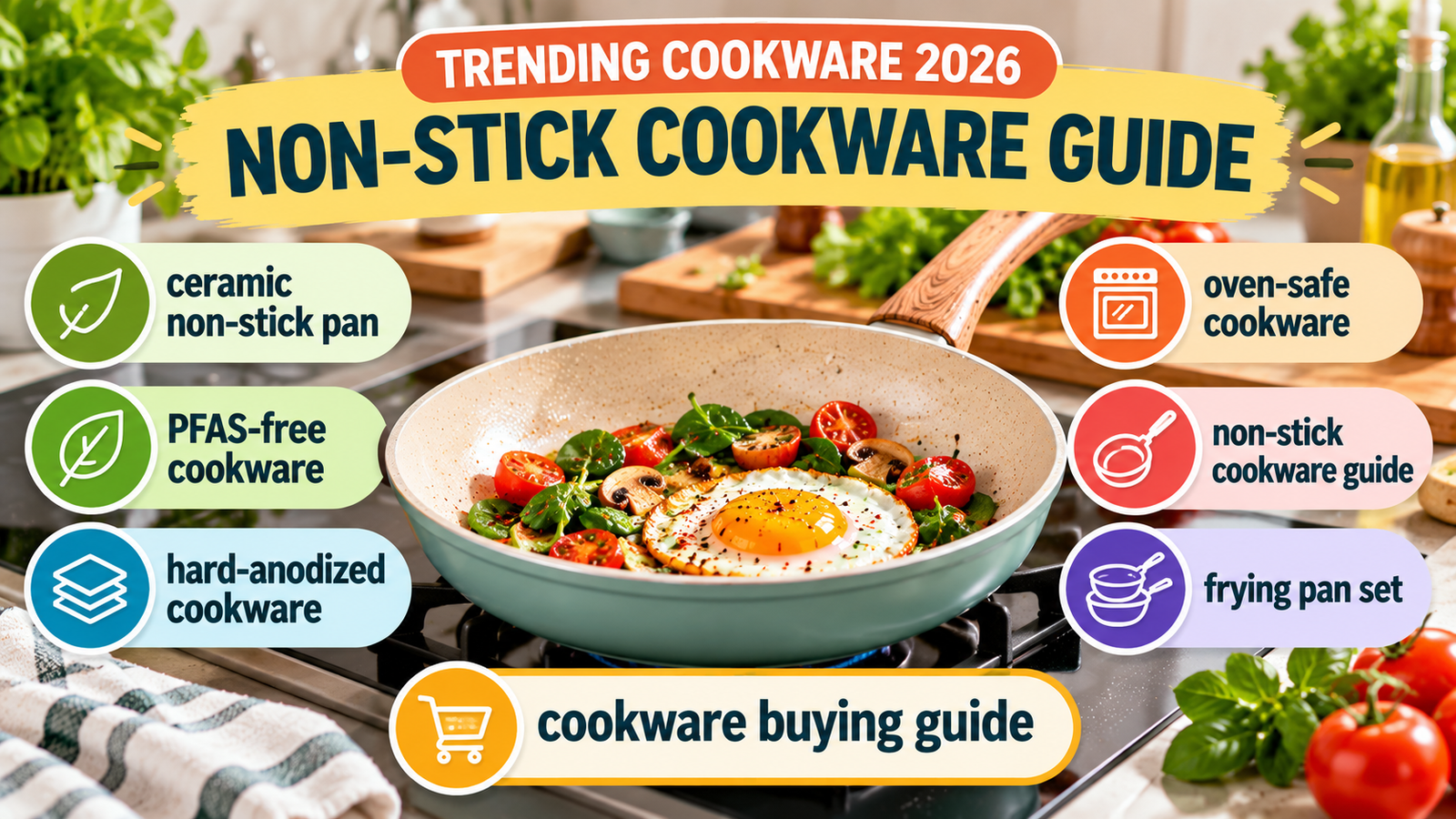
🍳 What Makes a Good Non-Stick Pan?
A quality non-stick pan should offer more than a slippery cooking surface. The right cookware should heat evenly, remain stable on the cooktop and be comfortable to use. Your cooking habits, preferred coating and cooktop type should all influence your choice.
Even Heating
A well-designed pan should distribute heat consistently across the cooking surface. Even heating can make everyday foods such as eggs, pancakes and vegetables easier to cook.
- Helps reduce uneven cooking
- Useful for everyday meals
- Look for a well-constructed base
Sturdy Construction
A sturdy pan can provide better stability and may be less prone to movement on the cooktop than an extremely lightweight design.
- Consider base thickness
- Look for balanced construction
- Check handle attachment
Durable Non-Stick Surface
Non-stick coatings can make cooking and cleanup easier. However, different coatings have different care requirements, so always follow the manufacturer’s instructions.
- Check the coating type
- Follow recommended care instructions
- Avoid unnecessary surface damage
Choose the Right Size
The best pan size depends on how many people you normally cook for and the types of meals you prepare.
- 8-inch – individual portions
- 10-inch – versatile everyday size
- 12-inch – larger portions and family meals
🌿 PFAS-Free vs. Hard-Anodized: What’s the Difference?
PFAS-free and hard-anodized are not necessarily competing descriptions. They refer to different aspects of cookware, so understanding the distinction can help you compare products more accurately.
PFAS-Free Options
PFAS-free cookware is generally marketed without intentionally added PFAS in the cooking surface or specified components. Ceramic-coated cookware is one popular option marketed as PFAS-free.
- Check the manufacturer’s PFAS statement
- Do not rely only on the word “ceramic”
- Review complete product specifications
Hard-Anodized Cookware
Hard-anodized aluminum cookware uses an electrochemical process to harden the aluminum surface. It is known for durable construction and resistance to corrosion.
- Describes cookware construction
- May have a separate non-stick coating
- Check the specific coating information
💡 Important Buying Tip
Hard-anodized cookware is not automatically PFAS-free. If avoiding PFAS is important to you, check the manufacturer’s specific coating information rather than assuming based on the cookware’s construction.
🏋️ Heavy Base vs. Warping
Have you ever placed a pan on the stovetop and noticed that it doesn’t sit completely flat? A pan’s construction can make a difference. A thicker or heavier base can provide better stability and heat distribution, although a heavy base does not guarantee that cookware will never warp.
Rapid temperature changes can contribute to cookware distortion. For example, placing a very hot pan directly under cold running water can create thermal shock.
🛡️ How to Reduce the Risk of Warping
- Avoid extreme temperature changes.
- Don’t overheat an empty non-stick pan.
- Use the appropriate burner size.
- Avoid temperatures beyond the manufacturer’s recommendations.
- Allow the pan to cool before washing it.
- Store cookware carefully to prevent scratches and dents.
🔥 Oven-Safe Buying Checklist
Planning to move your pan from the stovetop to the oven? Don’t assume that every non-stick pan is oven-safe. Always check the manufacturer’s specifications before using cookware in an oven.
Check the Maximum Oven Temperature
Look for the manufacturer’s stated maximum oven temperature. The limit can vary between cookware models.
Check the Handle Material
The cooking surface may tolerate oven temperatures that the handle cannot. Heat-sensitive materials may have lower temperature limits.
Check Lid Compatibility
If the pan comes with a lid, check the lid’s oven-safe rating separately. Glass lids, knobs and other components may have different limitations.
Check Broiler Compatibility
Oven-safe does not necessarily mean broiler-safe. Check the manufacturer’s instructions before placing cookware under a broiler.
Check Cooktop Compatibility
If you use an induction cooktop, make sure the pan is specifically designed for induction cooking.
🌿 Ceramic Non-Stick Pans: Are They Worth Considering?
Ceramic-coated pans have become popular among shoppers looking for alternatives to traditional non-stick cookware. They can be useful for everyday foods such as eggs, pancakes, omelets, vegetables, fish and grilled sandwiches.
However, ceramic coatings can lose their non-stick performance over time, particularly when exposed to excessive heat, abrasive cleaning or unsuitable utensils.
💡 Care Tip
For longer coating life, use the care instructions supplied by the manufacturer and avoid unnecessary heat, scratching and abrasive cleaning.
🍳 Featured Non-Stick Frying Pans & Cookware Sets
Looking for a new non-stick pan or cookware set? Here are selected options covering PFAS-free cookware, ceramic non-stick pans, hard-anodized cookware, hybrid frying pans, large skillets and multi-piece frying pan sets. Check each Amazon product page for the latest price, availability, specifications and seller information.
Non Stick Frying Pans
Explore a non-stick frying pan option for everyday cooking, including eggs, pancakes, vegetables and other common meals.
- Non-stick frying pan
- Suitable for everyday cooking
- Check Amazon for current specifications
#ad
Nonstick Frying Pan Set – Honeycomb
A honeycomb-style nonstick frying pan set described as PFAS-free and designed for use across different cooktops.
- Honeycomb nonstick design
- PFAS-free
- All cooktops compatible
#ad
COOKER KING 3pc Hybrid Nonstick Frying Pans Set
A three-piece hybrid nonstick frying pan set with 8-inch, 10-inch and 12-inch pans for different cooking needs.
- 3-piece frying pan set
- 8, 10 and 12-inch sizes
- Hybrid nonstick design
#ad
Kikcoin Ceramic Nonstick Frying Pans Set
A three-piece ceramic nonstick skillet set with multiple sizes for everyday cooking and different portion requirements.
- 3-piece skillet set
- 8, 9.5 and 11-inch sizes
- Ceramic nonstick coating
#ad
HexClad 10″ Hybrid Nonstick Wok
A 10-inch hybrid nonstick wok designed for versatile cooking, with dishwasher-safe and oven-safe features and induction compatibility.
- 10-inch hybrid nonstick wok
- Dishwasher safe
- Oven safe
- Induction ready
#ad
CAROTE Nonstick Frying Pan – 8 Inch
An 8-inch classic granite nonstick skillet suitable for smaller portions and everyday cooking.
- 8-inch frying pan
- Classic granite style
- Nonstick cooking surface
#ad
Calphalon Hard-Anodized Nonstick Frying Pan Set
A hard-anodized nonstick frying pan set featuring 8-inch and 10-inch pans for everyday cooking.
- Hard-anodized construction
- Nonstick cooking surface
- 8-inch and 10-inch pans
#ad
SENSARTE Nonstick Frying Pan with Lid – 12 Inch
A 12-inch large deep frying pan with lid and helper handle, offering a larger cooking surface for family meals and sautéing.
- 12-inch large deep frying pan
- 5-quart capacity
- Includes lid
- Induction compatible
- PFOA and PFOS free
#ad
Tramontina Professional 10-Inch Non Stick Frying Pan
A 10-inch professional-style nonstick frying pan suitable for everyday stovetop cooking.
- 10-inch frying pan
- Nonstick cooking surface
- Professional-style cookware
#ad
SENSARTE Nonstick Frying Pan – Swiss Granite
A Swiss granite-style nonstick frying pan designed for omelets and everyday stovetop cooking.
- Nonstick frying pan
- Swiss granite-style surface
- Suitable for omelets and everyday cooking
#ad
Non Stick Frying Pans – 3 Piece Skillet Set
A three-piece skillet set with 8-inch, 10-inch and 12-inch pans, silicone heat-resistant handles and a PFOA/PFAS-free coating.
- 3-piece skillet set
- 8, 10 and 12-inch sizes
- Silicone heat-resistant handles
- PFOA and PFAS free coating
- Oven and dishwasher safe
- All stovetop compatible
#ad
🧽 How to Make Your Non-Stick Pan Last Longer
Use Suitable Utensils
Check the manufacturer’s instructions regarding metal utensils. When in doubt, silicone, wood or other recommended utensils can help minimize surface damage.
Avoid Excessive Heat
Non-stick cookware generally doesn’t need extremely high temperatures. Medium or medium-low heat is often sufficient for many everyday foods.
Store Carefully
If you stack cookware, consider using protective separators to reduce scratches and surface damage.
Clean Gently
Avoid abrasive pads and harsh cleaning methods unless they are specifically approved by the manufacturer.
📏 What Size Non-Stick Pan Should You Buy?
The ideal size depends on how many people you normally cook for and the type of food you prepare.
For Individual Portions
Useful for individual portions, eggs and smaller meals.
Versatile Everyday Size
A practical everyday size for couples or smaller households.
For Larger Portions
Better suited to family-sized portions, multiple eggs, pancakes, vegetables and larger meals.
If you’re buying only one non-stick pan, a 10- or 12-inch model can be a practical starting point for many kitchens.
✅ Non-Stick Pan Buying Checklist
Before buying your next pan, ask yourself:
- What coating does it use? Understand whether it is ceramic, PTFE-based or another type.
- Is it marketed as PFAS-free? If this matters to you, look for a clear manufacturer statement.
- Is the base sturdy? A well-constructed base can improve stability and heat distribution.
- Does it work with my cooktop? Check gas, electric, ceramic or induction compatibility.
- Is it oven-safe? Check the exact temperature limit.
- Is the handle oven-safe? The handle may have a different limitation from the pan itself.
- What size do I need? Choose based on your typical cooking quantity.
- How should it be cleaned? Follow the manufacturer’s care instructions.
🛒 Final Thoughts
The best non-stick pan isn’t necessarily the most expensive one. The right choice depends on your cooking habits, preferred coating, cooktop, required size and desired durability.
When comparing PFAS-free cookware and hard-anodized pans, remember that these terms describe different characteristics. Hard-anodized refers primarily to the cookware’s aluminum construction, while PFAS-free refers to the absence of PFAS according to the manufacturer’s stated specifications.
For everyday cooking, prioritize even heating, sturdy construction, suitable coating, comfortable handling and clear safety specifications. If you want an oven-safe pan, always check the manufacturer’s temperature limits rather than assuming that all cookware can safely go from stovetop to oven.
🍳 Ready to Choose Your Next Pan?
Compare the features, check the manufacturer’s specifications and choose the cookware that fits your kitchen and cooking style.
Explore the featured non-stick pans above and check Amazon for the latest product information and availability.
View Featured Pans🔎 More Shopping & Buying Resources
Explore more shopping deals, buying guides and product resources from our website:
Pingback: Halloween Shopping Ideas – Explore Now - Fresh Built Kitchen